
Context Engineering: The Evolution Beyond Vibe-Coding
From Space Invaders to Enterprise Software: How Context Beats Vibes Every Time

Introduction
The landscape of AI-assisted software development is undergoing a profound transformation. Consider this scenario: You type "Create me the game of Space Invaders in Python and Pygame" into an AI assistant, and within seconds, you receive a fully functional game. This is vibe-coding at its best—and it works brilliantly.
Why does it work? Three key reasons:
The LLM has absorbed thousands of descriptions of how Space Invaders works from across the internet
It has learned from millions of Python code examples
It understands Pygame's patterns from countless tutorials and implementations
This "one-shot" success feels like magic. But now try this prompt: "Implement the feature X for my customer Y on my existing codebase Z." Suddenly, the magic vanishes. The AI stares back blankly—it knows nothing about your feature X, your customer Y, or your codebase Z.
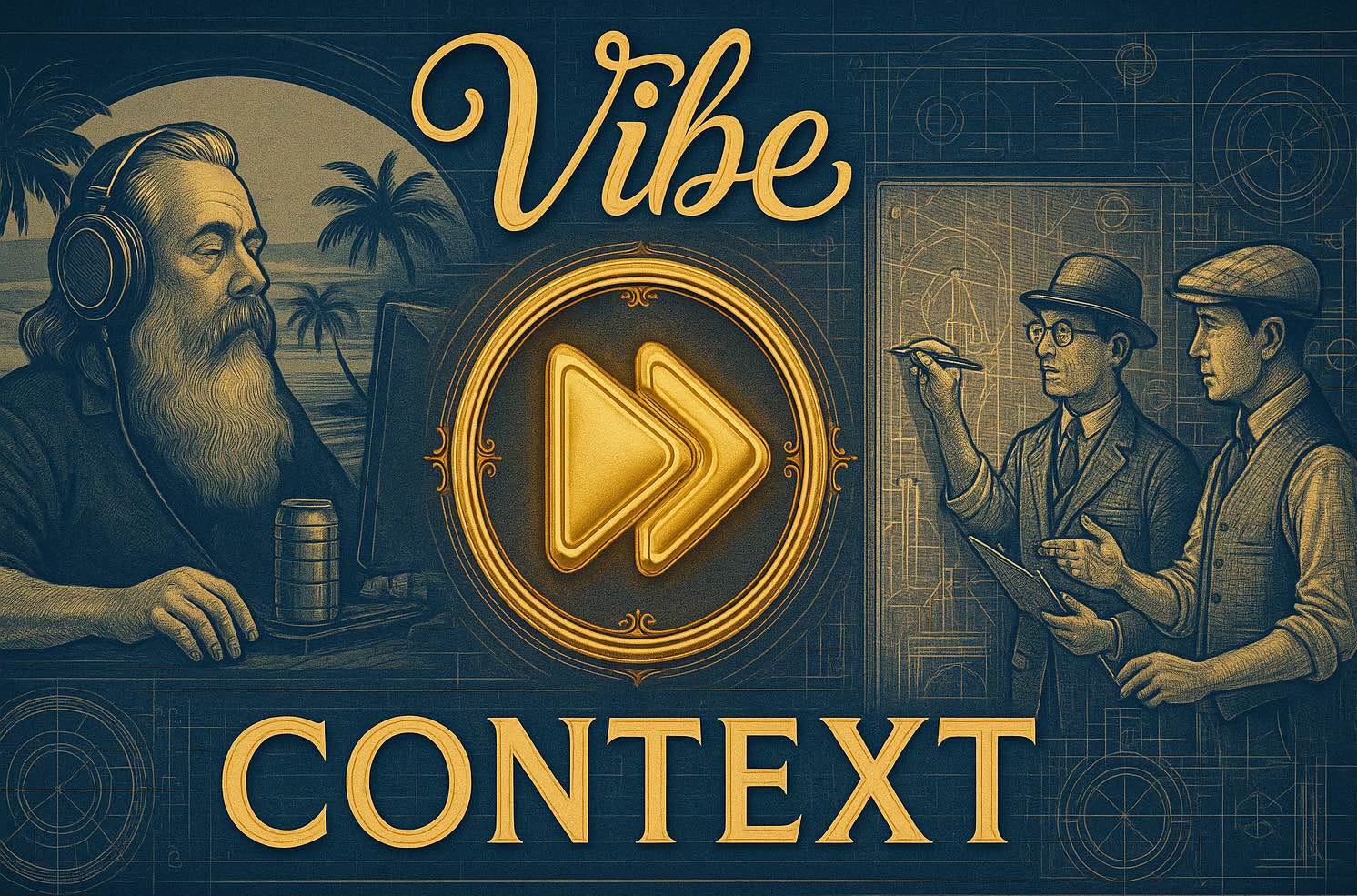
This stark contrast reveals both the power and the fundamental limitation of vibe-coding. What began as developers "vibing" with AI using natural language is evolving into something far more sophisticated: Context Engineering. As Andrej Karpathy—who coined the term "vibe-coding" in February 2025—now describes it, Context Engineering is "the delicate art and science of filling the context window with just the right information for the next step." This shift represents not just a technological advancement, but a fundamental change in how developers approach AI collaboration.
The Era of Vibe-Coding
Vibe-coding emerged as developers discovered they could describe what they wanted in natural language and receive surprisingly accurate code suggestions from LLMs. The term, popularized by Karpathy, captures the somewhat improvisational nature of the practice—developers would "vibe" with the AI, working within the constraints of what the model learned during training. As he put it, vibe-coding meant to "fully give in to the vibes, embrace exponentials, and forget that the code even exists."
When you're building a Space Invaders clone or implementing a binary search tree, vibe-coding excels. These are solved problems with thousands of examples in the AI's training data. But the moment you need to integrate with your company's proprietary API or follow your team's specific architectural patterns, the limitations become painfully clear. Research shows that 76.4% of developers lack confidence in unreviewed AI-generated code—a clear indication that vibe-coding, while fun and useful for prototypes, doesn't scale to production.
Limitations of Vibe-Coding
Generic Solutions: LLMs could only provide solutions based on common patterns from their training data—great for Space Invaders, useless for your customer Y's specific requirements
Lack of Project Awareness: No understanding of specific codebases, architectural decisions, or team conventions—the AI doesn't know that your codebase Z uses event sourcing or that customer Y requires GDPR compliance
Context Window Constraints: Limited ability to maintain awareness of larger project structures—feature X might touch 20 different files that the AI can't see
Outdated Knowledge: Solutions based on training data that might be months or years old—while Space Invaders hasn't changed since 1978, your codebase Z evolves daily
Enter Context Engineering
Context Engineering represents a paradigm shift where developers actively curate, manage, and optimize the knowledge available to AI assistants. Rather than relying solely on pre-trained knowledge, developers become architects of their AI's understanding.
Remember our "feature X for customer Y on codebase Z" prompt that failed? With Context Engineering, the AI would know:
What feature X entails, including acceptance criteria and edge cases
Who customer Y is, their specific requirements, and compliance needs
How codebase Z is structured, its patterns, and architectural decisions
This isn't magic—it's engineering. As Austen Allred, founder of BloomTech, emphatically states: "Context engineering is 10x better than prompt engineering and 100x better than vibe coding."
Key Principles of Context Engineering
Deliberate Knowledge Curation: Creating structured documentation specifically for AI consumption—transforming tribal knowledge about customer Y into explicit context
Dynamic Context Assembly: Tools that can read and understand project-specific files—allowing the AI to learn about codebase Z in real-time
Persistent Project Memory: Maintaining consistent context across development sessions—so tomorrow's AI still knows about feature X
Iterative Refinement: Continuously improving the quality and relevance of available context—as customer Y's needs evolve, so does their context documentation
The Role of Agentic AI Assistants
The emergence of agentic AI tools marks a turning point. These tools can:
Actively Explore Codebases: Read multiple files to build comprehensive understanding
Maintain Project Context: Store and retrieve project-specific information (e.g., CLAUDE.md files)
Execute Multi-Step Tasks: Perform complex operations that require understanding entire systems
Learn Project Conventions: Adapt to team-specific patterns and practices
From Vibe-Coding to Context Engineering: A Transformation
Consider how our examples transform with Context Engineering:
Vibe-Coding Era:
✅ "Create Space Invaders in Python" → Works perfectly
❌ "Implement feature X for customer Y on codebase Z" → Complete failure
Context Engineering Era:
✅ "Create Space Invaders in Python" → Still works perfectly
✅ "Implement feature X for customer Y on codebase Z" → Now works because the AI has access to:
Feature X specifications in
[features/X/CONTEXT.md]()Customer Y requirements in
[customers/Y/requirements.md]()Codebase Z architecture in
[CLAUDE.md]()Historical decisions in
[docs/ADRs/]()
The AI no longer needs to guess—it knows.
Context Engineering in Practice
The Transformation in Action
Before Context Engineering:
Developer: "Implement feature X for customer Y on codebase Z"
AI: "I don't have enough context about your specific requirements..."
Result: Frustrated developer, generic suggestions, manual work
After Context Engineering:
Developer: "Implement feature X for customer Y on codebase Z"
AI: Reads context files, understands architecture, knows customer requirements
Result: Working implementation that follows team standards and meets customer needs
1. Structured Documentation
Instead of traditional documentation written for humans, Context Engineering involves creating AI-optimized documentation. Now when you ask about "feature X for customer Y," the AI can actually deliver:
<!-- CLAUDE.md example -->
## Project Architecture
- Frontend: React 18 with TypeScript
- State Management: Zustand (not Redux)
- API: GraphQL with Apollo Client
- Testing: Vitest + React Testing Library

## Customer Y Specific Requirements
- Data residency: EU-only servers
- Authentication: OAuth2 with their corporate SSO
- Compliance: GDPR, requires audit logging
- Performance: <200ms response time for all API calls

## Feature X Implementation Guidelines
- Must integrate with existing notification system
- Follow event-sourcing pattern established in codebase Z
- Use feature flags for gradual rollout
- Coordinate with Customer Y's Thursday maintenance window
2. Context Files Strategy
Developers strategically place context files throughout their projects:
[CLAUDE.md]()at project root for high-level architecture of codebase Z[customers/Y/CONTEXT.md]()with customer Y's specific requirements and gotchas[features/X/README.md]()explaining feature X's business logic and constraintsAPI documentation in machine-readable formats
Decision logs explaining why certain approaches were chosen
Integration guides showing how feature X connects with customer Y's systems
This distributed context ensures the AI has the right information at the right level of detail—from the 30,000-foot view of codebase Z down to the specific validation rules customer Y requires for feature X.
3. Living Documentation
Context Engineering treats documentation as code:
Version controlled alongside source code
Updated as part of the development process—when feature X ships, its context documentation ships too
Reviewed in pull requests—changes to customer Y's requirements get the same scrutiny as code changes
Tested for accuracy and completeness—can a new developer use this context to work on codebase Z effectively?
4. Technical Implementation
The technical architecture of Context Engineering encompasses several sophisticated components:
Dynamic Context Assembly: LangChain identifies four critical context categories:
Instructions (prompts, memories, few-shot examples)
State (dynamic information evolving during execution)
History (previous interactions)
Tools (external capabilities)
Memory Systems: Operating at multiple levels
Short-term memory handles conversation summarization and scratchpad implementation
Long-term memory maintains persistent knowledge bases and learned patterns
Advanced implementations use namespace organization and semantic retrieval
Model Context Protocol (MCP): Anthropic's emerging universal standard provides:
Extensible architecture for connecting external data sources
Security frameworks with permission-based access
Cross-platform support with SDKs in Python, TypeScript, C#, and Java
Benefits of Context Engineering
For Individual Developers
Higher Quality AI Suggestions: More accurate, project-specific code generation—the AI can now implement feature X knowing exactly how it fits into codebase Z
Reduced Cognitive Load: AI understands project context without repeated explanation—no need to explain customer Y's requirements in every prompt
Faster Onboarding: New team members can leverage AI with full project context—they can contribute to feature X on day one
For Teams
Consistent Code Quality: AI suggestions align with team standards—feature X will follow the same patterns as the rest of codebase Z
Knowledge Preservation: Project decisions and rationale are explicitly documented—why customer Y needs specific compliance features
Scalable Collaboration: AI assistants become more effective team members—they know the difference between customer Y and customer A's requirements
For Organizations
Accelerated Development: Reduced time spent on boilerplate and routine tasks—feature X can be implemented in days, not weeks
Improved Maintainability: Better documented, more consistent codebases—future features for customer Y build on well-documented foundations
Competitive Advantage: Teams that master Context Engineering ship faster—while competitors struggle to onboard developers to their codebase Z equivalents
Real-world results validate these benefits:
Klarna achieved an 80% reduction in query resolution time
AppFolio reported 2x increase in response accuracy and 10+ hours saved per week
A wealth management firm saw 40% reduction in prep time for advisors
Y Combinator's winter 2025 batch experienced 10% weekly growth, with 25% of startups having 95% AI-generated code
Best Practices for Context Engineering
1. Start with Core Concepts
Document fundamental architecture decisions, key abstractions, and project-specific terminology. If Space Invaders needs no explanation, your feature X definitely does.
2. Focus on the "Why"
Include rationale for decisions, not just the "what" and "how." Why does customer Y need EU-only data residency? Why does codebase Z use event sourcing?
3. Keep Context Fresh
Establish processes to update context files as the project evolves. Customer Y's requirements will change; feature X will spawn features X.1 and X.2.
4. Optimize for AI Consumption
Use clear structure, consistent formatting, and explicit relationships between concepts. Make it impossible for the AI to confuse customer Y with customer A.
5. Measure and Iterate
Track how effectively AI assistants use provided context and refine accordingly. Can the AI now implement features for customer Y as easily as it creates Space Invaders?
6. Implement the "Four Pillars" (from LangChain)
Write: Store important information to external memory
Select: Retrieve only relevant context for each task
Compress: Summarize and filter to maintain efficiency
Isolate: Separate different context domains to prevent confusion
The Future of Context Engineering
As AI tools become more sophisticated, Context Engineering will likely evolve to include:
Automated Context Generation: Tools that analyze codebases to generate initial context—imagine AI automatically documenting what makes codebase Z unique
Context Validation: Systems that verify context accuracy against actual code—ensuring the documentation about customer Y's requirements matches the implementation
Cross-Project Learning: AI assistants that can apply patterns across multiple projects—learning that customer Y's patterns might benefit customer A
Team-Specific Fine-Tuning: Models adapted to particular team's coding style—where "create feature X" becomes as natural as "create Space Invaders"
Multi-modal Context: Integration of text, images, audio, and structured data into unified context systems
Adaptive Context Systems: AI learning optimal context configurations and adjusting in real-time based on task performance
Conclusion
Context Engineering represents a maturation of AI-assisted development. By moving beyond the limitations of vibe-coding, developers are creating a new discipline that treats AI context as a first-class citizen in the development process.
We've come full circle: Where once we celebrated that an AI could create Space Invaders from a simple prompt, we now engineer systems where that same AI can implement feature X for customer Y on codebase Z with equal confidence. The difference isn't in the AI's capabilities—it's in how we prepare and present the context.
The teams that master Context Engineering won't just write code faster—they'll build better systems with AI as a true collaborative partner. As we stand at this inflection point, the question isn't whether to adopt Context Engineering practices, but how quickly we can evolve our development workflows to embrace this new paradigm.
The age of hoping AI "gets" what we mean is over. The age of deliberately crafting what AI knows has begun. And unlike Space Invaders, your codebase Z deserves more than what the internet already knows—it deserves Context Engineering.
As Karpathy himself noted, moving from prompt engineering to context engineering: "+1 for 'context engineering' over 'prompt engineering'." His journey from coining "vibe-coding" to championing Context Engineering illustrates the natural evolution of our understanding. The future belongs to those who master this new discipline.
References
Karpathy, A. (2025). "Vibe Coding MenuGen." karpathy.bearblog.dev.
Analytics India Magazine. (2025). "Context Engineering is the New Vibe Coding." AIM. June 27, 2025.
Indika, S. (2025). "RIP Vibe Coding – Why Context Engineering Is the New Frontier of AI Development." LinkedIn Article, July 3, 2025.
Kunkunuru, S. (2025). LinkedIn post on context engineering. June 2025.
Gupta, M. (2025). "What is Context Engineering? The new Vibe Coding." Data Science in Your Pocket, Medium, June 2025.
Anthropic Engineering. (2025). "Claude Code: Best practices for agentic coding." April 18, 2025.
LangChain Blog. (2025). "Context Engineering for Agents." July 2, 2025.
LangChain Blog. (2025). "The rise of 'context engineering'." June 2025.
Anthropic. (2025). "Introducing the Model Context Protocol."
Y Combinator. (2025). "Y Combinator startups are fastest growing, most profitable in fund history because of AI." CNBC, March 15, 2025.